
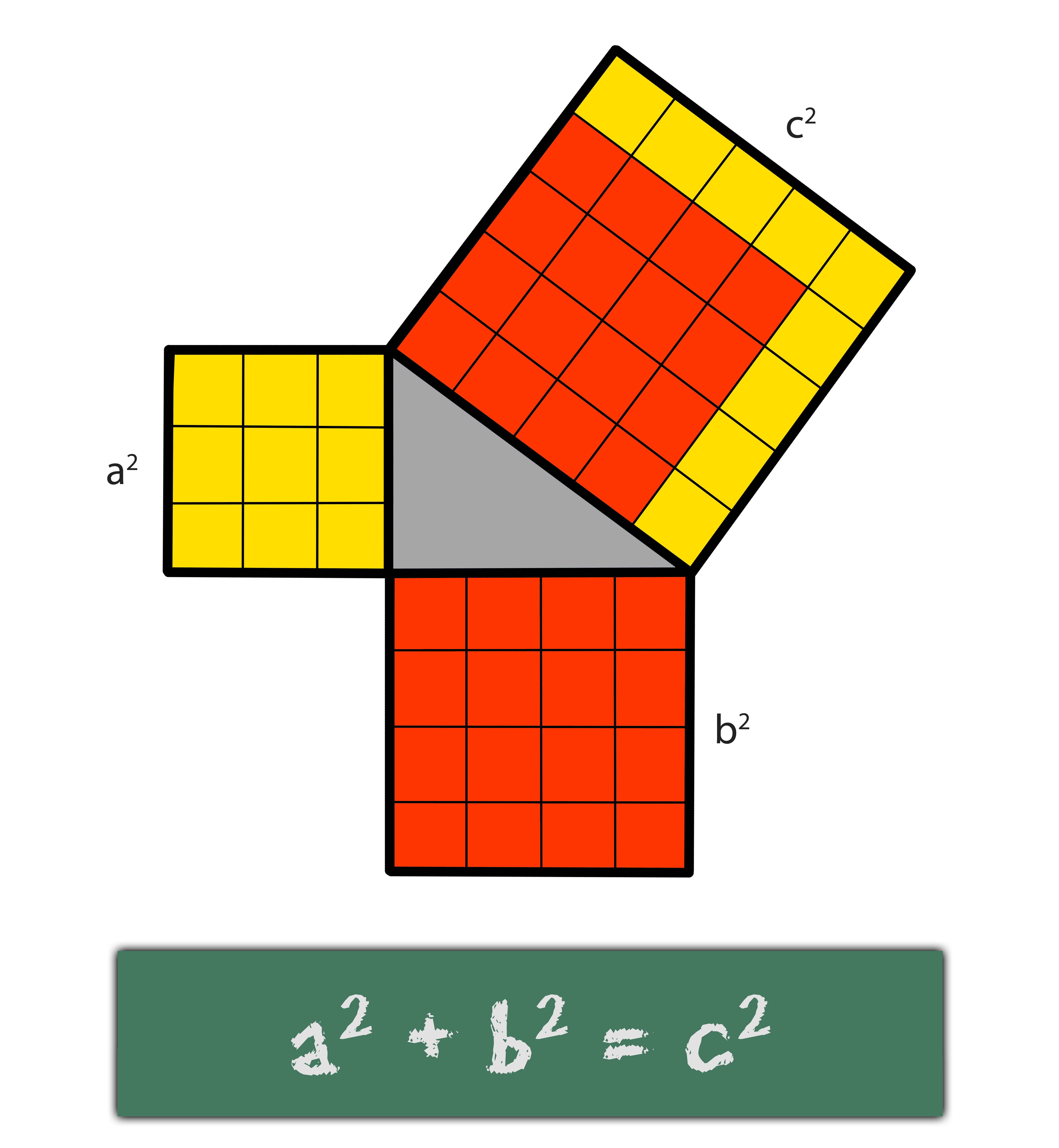
The Pythagorean Theorem states that, in a right triangle, the two smaller squares made from the triangles legs add up to equal the biggest square made from the hypotenuse.

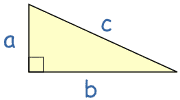
The lengths of the legs are commonly labeled as a and b and the hypotenuse length is labeled as c.

REMEMBER:
HYPOTENUSE: c is the longest side of the triangle
LEGS: a and b are the other two sides

What is the Pythagorean Theorem?
In short the Pythagorean Theorem can be explain with the formula below.
a2 + b2 = c2
AGAIN, THIS IS ONLY TRUE FOR RIGHT TRIANGLES!
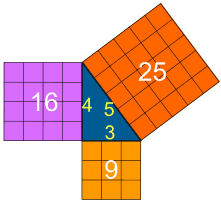
Here are other examples:
When not knowing the Pythagorean Theorem can cost you $15,000.
 Math With Mrs. Molina